NAIROBI (Reuters) - Kenya's President Mwai Kibaki leads Thursday's presidential election with 47.4 percent of the vote, versus 42.7 for opposition leader Raila Odinga, according to an exit poll by a local independent observer group.
The Institute for Education in Democracy (IED), a respected non-governmental organisation, gave the figures -- which it was constantly updating on its Web site -- at 8 p.m. (1700 GMT) based on more than 260 polling stations out of 20,000.
But an Odinga aide dismissed the exit poll, saying it did not reflect reality.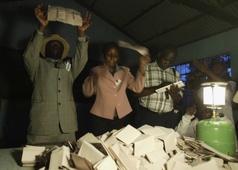
"Exit polls are something alien to Kenya," Salim Lone told Reuters. "People, especially in rural areas, are not keen to say how they have voted because the fear the power of the state."
Millions of Kenyans voted throughout Thursday in an election marred by delays, sporadic violence including three deaths, and rigging charges from the opposition.
Kibaki, 76, is vying for the top job with former ally Odinga, 62, who is determined to realise a long-held dream of leading the region's top economy. Counting began immediately on Thursday evening, and official results were due on Friday.
Voters across the east African country's humid coast, shantytowns and lush highlands cast ballots in the tightest contest since independence from Britain in 1963.
Kibaki, whose National Rainbow Coalition unseated Kenya's 39-year ruling party in 2002, faces the possibility of losing his re-election bid despite a sound economic record and the backing of his Kikuyu tribe, the country's largest.
If Kibaki loses, he will be Kenya's first sitting president ousted at the ballot box. Analysts say the chance of a second transfer of power in two elections shows democratic maturity. Others fear it heightens the potential for trouble.
VIOLENCE
Near Nairobi's vast Kibera slum, gunmen shot dead one man and wounded two others near a polling station. Police called it "thuggery" but the opposition said the attack was on its agents.
In the opposition heartland of Nyanza, in west Kenya, a mob chased a man accused of killing a relative of a local politician two months ago, police said. When he hid in a sugar plantation, they set it alight and beat him to death as he fled.
Also in Nyanza, opposition supporters killed an agent of a rival party, whom they had accused of bribery, by tossing him out of moving car, a security source said. "He died on the spot. Six other (accused agents) were handed over to the police."
Many of the 14 million eligible voters began queuing long before voting stations opened at 6 a.m. (0300 GMT) for the concurrent presidential and parliamentary votes.
Because of delays in opening, about a quarter of the 27,000 polling stations were kept open after the 5 p.m. (1400) closing deadline, the Electoral Commission of Kenya (ECK) said.
The delays stoked tensions in areas including Kuresoi, where police fired teargas to chase away voters furious their names were missing from registers. In the northern town of Garissa, police also used teargas to disperse voters turned away for arriving late, witnesses said.
Tempers also frayed in Odinga's Nairobi constituency.
After complaining to the ECK that his name was missing, Odinga -- who has led pre-election opinion polls -- was mobbed by fans as he returned to vote in Kibera, Kenya's biggest slum.
He said the mix-up had been a "deliberate attempt" by the government to rig the outcome in his constituency, but Kibaki's party said he had gone to the wrong voting booth.
"Rigging claims are an attempt to subvert the election process. Raila and his team do not want to accept the results if they lose," Kibaki's Party of National Unity (PNU) said.
Chief EU election observer Alexander Graf Lambsdorff said he had seen no evidence of fraud. "The day has fulfilled our hopes in that it has been conducted in a peaceful atmosphere with no intimidation," he told Reuters.
CHRISTMAS DELAYED
Kibaki, who voted near his home in Othaya, a fertile central region of tea and coffee farms, said he was sure of victory.
Many supporters of Odinga, a former political prisoner jailed by Kibaki's predecessor Daniel arap Moi, believe the Kikuyu have had it too good under the current administration.
"We didn't celebrate Christmas," said Feni Ojwang, a housewife in Odinga's Nyanza birthplace, a western region of picturesque valleys that belie its deep poverty.
"The goat and chicken I bought are still in the house. We will not slaughter them until Raila is declared winner."
Some 60,000 police and security agents patrolled the more than 20,000 polling stations. Police boss Hussein Ali warned agitators: "If it means shooting them, we will shoot people."
While Odinga's style contrasts with Kibaki's, both pledge to boost growth and provide free secondary education.
The candidate who receives more votes than his closest challenger, plus 25 percent in five of eight provinces will win.
SOURCE: Reuters, December 27, 2007