
By Basil Katz
Friday, February 19, 2010
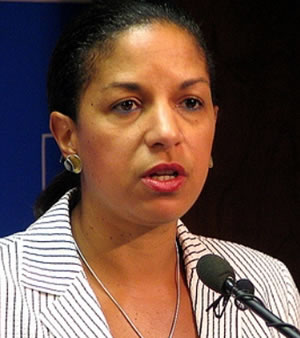 US Ambassador to the UN Susan Rice |
advertisements
"The reason why aid is not now proceeding to the people of southern Somalia is one reason alone and it's quite clear: it's al Shabaab's attacks on WFP and other U.N. agencies, its kidnapping of innocent relief workers, its extortion of funds," she said.
The World Food Program announced on Jan. 5 it had suspended its work in much of southern Somalia due to threats by al Shabaab, which Washington accuses of being al Qaeda's proxy in Somalia. The U.N. agency has denied U.S. concerns that some aid has been diverted to rebels.
"No U.N. agency has paid any money to al Shabaab," Bowden told journalists in Nairobi on Wednesday.
WFP spokesman Peter Smerdon in Nairobi on Wednesday also denied that food aid meant for Somali civilians was finding its way into the hands of al Shabaab, which controls much of southern and central Somalia. A WFP internal investigation had found no evidence of diversions to the group, Smerdon said.
The U.S. State Department said it remained concerned about the issue. "In the case of Somalia we do have concerns that aid was being diverted or money was exchanging hands," State Department spokesman P.J. Crowley said on Friday. "We're not going to pay a terrorism tax to al Shabaab."
"The U.S. is the largest donor of humanitarian assistance to Somalia," Rice said. "We have been consistently over many years."
Somalia has lacked an effective central government since 1991. An African Union peacekeeping mission in Somalia is slowly being built up. It currently consists of about 5,200 troops and will eventually increase to 8,000. (Additional reporting by Andrew Quinn in Washington; Editing by Patrick Worsnip and Bill Trott).
Source: Reuters