
By Katie Nguyen and Frank Nyakairu
Friday, October 23, 2009
|
REUTERS/WORLD VISION/Michael Arunga/Handout |
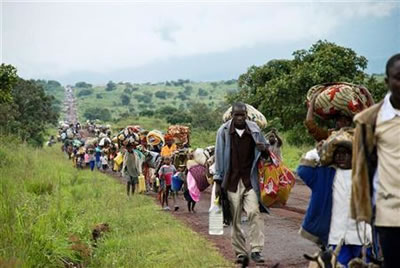
Africa is home to almost half the world's internally displaced people (IDPs) with 12 million, most of them sheltering in ramshackle camps, shantytowns or among local communities.
Unlike refugees, who have fled to another country and have a global U.N. agency dedicated to protecting their rights, IDPs benefit from little or no protection.
Ugandan President Yoweri Museveni, who hosted an AU summit in Kampala on the issue, hailed the pact as an "historic agreement aimed at protecting and assisting our brothers and sisters, the internally displaced".
The convention, which integrates the main aspects of international humanitarian law, would oblige AU states for the first time to prevent displacement, come up with solutions to the causes of displacement and provide IDPs with basic rights.
Signatories on Friday included Zimbabwean President Robert Mugabe and Sheikh Sharif Ahmed, the president of Somalia -- which has Africa's third largest IDP population after Sudan and Democratic Republic of Congo.
Aid officials and civil society groups have praised the AU for addressing a problem that is an obstacle to development and stability -- and for producing the first legally-binding agreement on internal displacement with a continental scope.
"This instrument clearly demonstrates that African leaders are conscious of the difficulties that displaced persons experience and are poised to as much as possible to put an end to their suffering," said AU Commissioner for Political Affairs Julia Joiner.
She urged leaders to "turn intention into action" and said implementation of the convention was key to its success.
Under the convention, states that are unable to assist IDPs can seek help from humanitarian organisations. Delegates to the summit said international aid agencies may use that as leverage to increase pressure on AU states to ratify the pact.
Delegates also said the convention underwent last-minute changes to an article on the obligations of rebels to IDPs after several countries, including Zimbabwe, raised concerns that the original wording gave legitimacy to such groups.
Source: Reuters, Oct 23, 2009