|
|
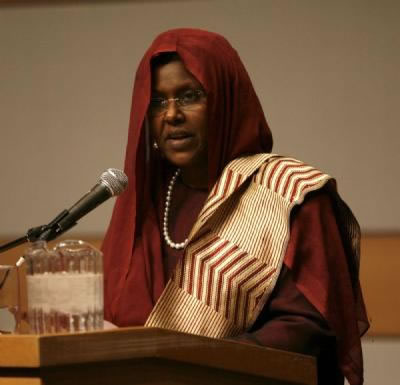
"Education, education, education," she said, "especially the women."
Education, Amin said, is the only way to freedom. Education, she said, brought her a national platform to advocate for women and for peace in war-torn Somalia.
Education, she said, will empower women, keep them from poverty and allow men and women alike to claim their human rights.
Amin spoke Thursday night to a small audience at the Salt Lake City Main Library as part of a Worldwide Influence of Women for Peace Event sponsored by the city and the University of Utah. None of the Somalian refugees now living in Utah attended. But Amin, the only woman on Somalia's Peacemaking Task Force, had them in mind as she spoke about the ongoing war in their shared homeland.
The war put Amin and her husband, whom she had known from childhood through studies at the same university, on different sides of warring clans. As factions developed, Amin found herself viewed as a traitor by her birth clan and a spy by her husband's.
Amin embraced the only undisputed identity she had left -- her womanhood. In 1992 she co-founded "Save Somali Women and Children" and then later the Sixth Clan movement, which brought together women in cross-clan marriages.
The group successfully lobbied for a voice alongside the five male-dominated ruling clans in the country's peace talks in 2000 and won a role for women in charting the country's future.
Today, there are 33 women serving in Somalia's parliament and the pronoun "she" has literally been incorporated in the country's governing charter.
Amin's peace efforts have brought her political and humanitarian recognition.
She was named to the Transitional Federal Parliament, a post she held through this year. Last month, she received a Clinton Global Citizen Award from former President Bill Clinton's foundation. In 2008, Amin was one of several recipients of the "Right Livelihood Award," which recognizes individuals working to overcome "urgent challenges." It is referred to as the "Alternative Nobel Prize."
In her acceptance speech last year, Amin noted that women and children are always the "first and last victims of war, though war is neither their desire nor their decision."
Her own sense of being divided between two warring clans "made me realize that war has nothing to offer women except for death, destruction and devastation," she said then. "And that is where my motivation to take the risk to work for peace has come."
On Thursday evening, Amin described her formula for becoming a social activist: "I believe that if you have the commitment and the passion about something, you can do a lot. Our example could be taken as a practical example."
That formula is driving her newest effort -- the Women and Girls Education Center, launched in 2001 -- as a method to further peace, independence and prosperity. She looks to herself as an example.
Amin said her mother, a polygamous wife, made the "uncommon" decision to send her three daughters to a Quaranic school. Cultural stigma prevalent then held that educated girls would not make good wives, she said.
"She was very ahead of her time," said Amin, who raised four children in a "very happy" family with her husband, who traveled to Utah with her.
Amin considers the education center she helped start with personal funds one of her most notable achievements. The center, supported by humanitarian funds and donations from people like British musician Peter Gabriel, has provided more than 1,700 women and girls with education and job training.
Now, Amin is raising funds to expand the center and set others up throughout Somalia, with a simple premise.
"Education changed my life and provided opportunities for me," she said.