
Monday, November 02, 2009
For two decades now, Somalia has experienced protracted turmoil. Since the 1990 fall of the Syad Barre regime, Somalia has been left with no central administration. This prolonged unrest is fuelled by the War Lords’ control over the different regions and towns of the country as well as in the diverse neighbourhoods of its war-torn capital-city, Mogadishu: failed State, failed public services and peace processes, considerable internal displaced populations (IDPs) and massive numbers of refugees fleeing to neighbouring Kenya (already 190,000 Somali refugees in Dadaab), under-development and recurrent famines
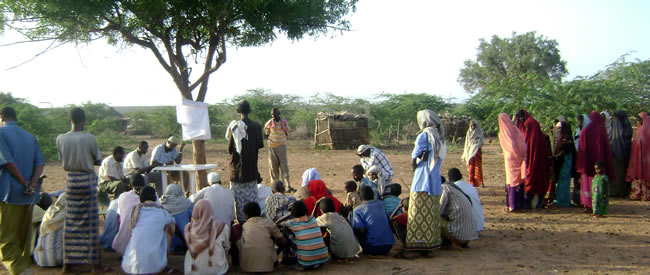
The humanitarian situation in Somalia has been, alas unsurprisingly, aggravated with the presence of 1.5 million IDPs. The exponential raise of food prices since 2008, the regular droughts of the last three years and the recent clashes between the ‘Al Shabab’ Islamists groups, the War Lords and the transitional government forces, account for the global instability and the displacements of populations.
According to the United Nations, today 3.8 million of Somalis are in dire need of emergency humanitarian relief. This corresponds to half of the total estimated population in the country. In addition to the colossal needs, widespread insecurity greatly limits NGOs’ access to beneficiary populations. Since the wave of kidnapping of aid workers in 2008 and 2009, to pursue humanitarian missions in Somalia has been hazardous. To counter this threat, international NGOs rely on Somali NGOs, who are better able to deal with the security constraints.
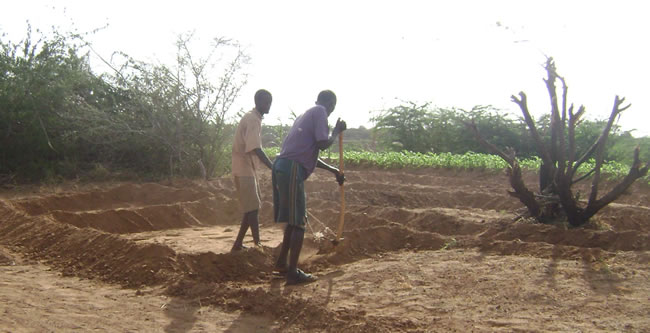
When the time to harvest came, almost 13,000 tons of corn were produced by the programme’s beneficiary farmers; 3,400 tons of sorghum, 4,400 tons of sesame and almost 3,000 tons of beans were harvested in the area of intervention. Substantial rains in the Horn of Africa region have been decisive in enabling these yields.
Beyond its strict input for the beneficiaries, this first project in Somalia benefited to the entire population of Burdhubo and Sakow sub-regions, which gained from improved food security in the area.
Source: ACTED, Nov 02, 2009