
By Duncan Miriri and Nick Tattersall
Monday, February 04, 2008
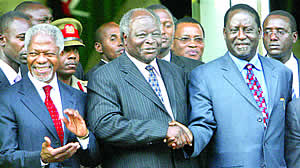 NAIROBI (Reuters) - Former U.N. chief Kofi Annan brought Kenya's rival sides together on Monday to try to end a month of post-election bloodshed, but his efforts to solve ethnic strife hit a new setback when a top mediator quit.
Annan brokered a deal between feuding politicians on Friday to act within 15 days to halt violence that has killed 900 people and negotiate an end to a political standoff triggered by President Mwai Kibaki's disputed Dec 27. re-election.
He said the two sides would then tackle a longer term solution to the deep ethnic divisions laid bare by the political impasse and selected South African business tycoon Cyril Ramaphosa to head that stage of the negotiations.
"I thought I should withdraw and go back to South Africa so I don't become a stumbling block myself," said Ramaphosa, the chief negotiator for South Africa's African National Congress in talks that brought a peaceful end to apartheid in 1994.
But he denied having business links with the opposition.
Underscoring the challenge for mediators, Kibaki and Odinga have continued to trade harsh words, accusing each other of trying to sabotage talks. Clashes between groups of youths backing one side or the other raged over the weekend.
Kibaki says he fairly won the vote that returned him to power and accuses Odinga of fanning violence. Odinga says Kibaki stole victory and refuses to recognise him as president.
WEEKEND OF VIOLENCE
Kenya's image as a stable and prosperous African state has suffered badly as a result of a crisis.
What started as a political dispute has uncorked decades-old divisions between tribal groups over land, wealth and power, dating from British colonial rule and stoked by Kenyan politicians for personal gain during 44 years of independence.
At least 900 people have been killed in ethnic violence and clashes with the security forces. Some 300,000 have been forced to flee their homes in one of modern Kenya's worst periods.
Talks between the rival sides resumed on Monday with a Red Cross briefing on the extent of the bloodshed, officials said.
Kenya's Foreign Affairs Minister Moses Wetangula, just back from an African Union summit where Kenya was in the spotlight, said the east African regional bloc IGAD -- chaired by Kenya's government -- would be involved in efforts to end the crisis.
But an opposition spokesman dismissed the invitation to IGAD ministers as an attempt by the Kibaki government to win recognition from neighbouring states.
Wetangula said both sides had made statements "that could spoil the mediation talks" and urged a rapid solution.
"We cannot afford to be a permanent feature on television screens for all the wrong reasons," he said.
In the volatile and ethnically mixed western region, gangs fired arrows and threw rocks at each other in front of police who were unable or unwilling to intervene on Sunday.
On Monday, residents said calm had returned save for a little looting, and urged the politicians to get to work.
"Raila and Kibaki must be serious. They must not talk together and then go to the press saying something different. They should agree on what they tell Kenyans. We are confused," farmer Sylvester Barake said, sitting in an empty gas station.
Source: Reuters, Feb 04, 2008