Malnutrition, disease rage amid civil war

By Edmund Sanders
Thursday, September 27, 2007
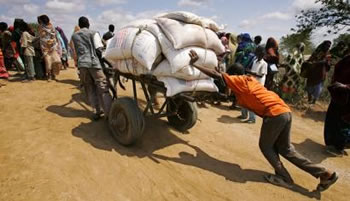 |
| A Somali boy helped push a donkey cart loaded with food aid that the UN World Food Program distributed yesterday in Yowhar. (ROBERTO SCHMIDT/AFP/Getty Images) |
But scarcely a sound escaped from the baby's throat, and she sank back exhausted into her mother's arms.
It's been a struggle since the day Shukri was born. The next morning, her mother walked three days to escape shelling in Mogadishu that had killed her husband. Now settled with her mother in a displacement camp in Jowhar, north of Mogadishu, Shukri is likely to die quickly unless admitted to a hospital.
Last week, John Holmes, United Nations emergency coordinator, said conditions in Somalia had eclipsed those in Darfur and Chad as the most pressing African humanitarian crisis. Malnutrition and disease are soaring in Somalia amid political insecurity and a string of natural disasters, including flooding and drought.
With many Western charities afraid to work in the dangerous country, the transitional government is struggling to cope but lacks experience and funding. Recently, aid groups contend, the government exacerbated the crisis by attempting to tax incoming humanitarian assistance, setting up roadblocks that hinder food deliveries, and intimidating charities and the displaced by accusing them of supporting terrorists.
About 350,000 Somalis remain refugees from fighting earlier this year in Mogadishu between government soldiers, supported by thousands of Ethiopian troops, and an insurgency consisting of antigovernment clans and Islamist fighters. About 1.5 million people require humanitarian aid, an increase of 50 percent in recent months.
Malnutrition rates are skyrocketing. About 17 percent of children nationwide, or 83,000, are malnourished, according to UNICEF. Some 13,500 children, including Shukri, are so severely malnourished that they are at risk of starvation.
After 16 years of civil war and clan fighting, Somalis are accustomed to hardship. There hasn't been a fully functioning government since 1991. But the displacement crisis and natural disasters are pushing the emergency to a new level and into new areas.
Jowhar had long been an island of stability and agricultural prosperity in southern Somalia. Now, the nation's breadbasket requires food assistance itself for the first time since a nationwide famine from 1991 to 1993. Nearly 8,700 children are at risk of starvation, according to UNICEF.
"Around here we've never seen this," said Owliyo Moalim, 44, a mother of five, as she lined up Monday with hundreds of other local women to receive a World Food Program distribution of corn, beans, and oil.
Her family used to harvest crops every three months, but consecutive floods have prevented harvesting since October 2005, she said.
Somalia is also paying the price of years of anarchy, some residents said.
Source: LA Times, Sept 27, 2007