advertisements
While piracy is at its worst ever in Somalian waters, it is notable that the reported attacks are concentrated against commercial shipping and not against yachts. This article is valuable for cruising sailors intending to sail through the Red Sea on their way to Europe, however, because it identifies the current areas most affected by piracy, which has changed in the last few years from waters in the Gulf Aden to waters close to the Strait of Bab el Mandeb where the Red Sea meets the Gulf. The following report was produced by Oxford Analytica, which is an international, independent consulting firm drawing on a network of over 1,000 senior faculty members at Oxford and other major universities and research institutions around the world.
In the first nine months of 2007, 36 pirate attacks and attempted attacks were recorded in the seas around the Horn of Africa and Arabian Peninsula, an area bounded by Somalia, Djibouti and Yemen. This is more than twice the figure for the same period a year earlier, and equates to over 18% of the tally for worldwide attacks to September 2007.
The most severely affected waters are off Somalia, reflecting:
--the near-total absence of coastal or port surveillance across large swathes of the country;
--the defeat of the Council of Somali Islamic Courts in December 2006, which had
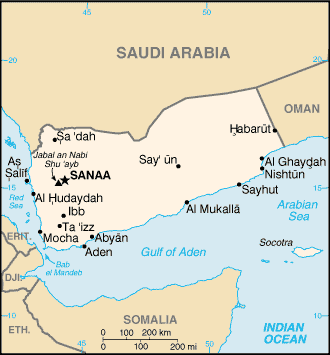 |
| 'Where the Gulf of Aden meets the Red Sea - now the area of most piracy attacks' |
--powerful motivation in the form of poverty and desperation--human development statistics compiled by international relief agencies typically designate over 70% of the Somali population as undernourished.
In these nine months, 26 incidents against ships sailing in or near Somali waters were recorded--an increase of 188% year-on-year.
The largest and most active pirate group is the so-called Somali Marines, which is based around Ceel Huur, some 250 miles north of Mogadishu. The group is thought to have 75 to 100 members and access to a wide assortment of weaponry, including AK-47 assault rifles, 12.7 mm and 14.5 mm heavy machine guns, anti-personnel mines and rocket launchers.
Hijacking ships for ransom is one of the most common forms of piracy around the Horn. During the first nine months of 2007, nine actual and 20 attempted attacks of this sort occurred, most carried out by Somali-based militias who have virtual free run of the region:
--Gangs usually operate close to shore, either luring vessels into an ambush with fake distress calls or approaching ships directly, using small, fast and highly maneuverable attack craft.
--Pirates have mounted assaults from a 'mother ship' to extend their range of operation, with some seizures taking place as far as 260 nautical miles off shore.
--In most cases, the crew is quickly rounded up, taken ashore and imprisoned until a ransom is extorted.
--If captured ships are small enough, they will also be seized and anchored in inlets under militia control.
Release payments, typically described as 'fines' imposed for the theft of sovereign fishing resources, start high, and have occasionally exceeded $1 million. In most cases, the pirates will compromise, and may well agree to a final settlement that is between one-half and one-quarter the amount of the initial demand. However, the International Maritime Bureau (IMB) says the overall scale of syndicate extortion is markedly higher now than ever before.
Attacks have also taken the form of more 'traditional' cargo theft. Assaults are typically carried out against ships as they:
--transit the heavily congested Bab el-Mandeb Strait;
--await designated entry time-slots at anchorages off the Djibouti coast;
--sail inside the 50-nautical-mile safety limit the IMB has recommended for passages along the East African coast (200 nautical miles in the case of Somalia).
Diesel and liquefied natural gas tankers have proven an especially attractive target. Other carriers have also been attacked, including cruise ships, freighters transporting automobile equipment, and increasingly, vessels ferrying humanitarian and food aid to war-torn Mogadishu.
IMB Director Captain Pottengal Mukundan has warned that if the navies of the international coalition forces operating in the Gulf of Aden and Arabian Sea do not do more to intercept and apprehend suspicious craft, these opportunist attacks will continue unchecked.
As part of the U.S.-led Operation Enduring Freedom's Horn of Africa theatre, based in Djibouti since 2002, there have been patrols of the region's waters involving naval forces from the U.S., Germany, France, the U.K., Italy and other allied forces, though their impact on piracy has been limited so far.
To learn more about this subject, go to the Oxford- Analytica Website .
SOURCE: Oxford Analytica/Sail-World, November 29, 2007