Free Press Staff Writer
A warm spell hit Burlington in late October. Perfect soccer weather, the kind of days Noor Bulle, a senior at Burlington High School, lives for -- playoff season, must-win games.
Bulle, 17, would score four goals in two playoff games to lead the Seahorses to the Division I boys soccer semifinals.
The games on a field in this country were imagined years before. Bulle talked about playing in the States when it seemed his family might, at last, leave the U.N.-run refugee camps in Kenya where they lived for more than a decade.
"What are you going to do if you ever go to the United States?" Bulle recalled being asked, more than three years ago, by an immigration official. His family was being processed for refugee status and relocation to the United States.
"Football," Bulle told the man. He was alone and scared during the questioning.
His family had heard stories about children who were interviewed without their parents. The kids, people said, were tripped and "failed" -- possibly costing their families the long-awaited journey to the United States.
"My parents were really worried," Bulle said.
But Bulle was asked just one question. He answered with just one word. Football.
"The INS black American, he just laughed and smiled and said, 'That's good. If you go there, you got to learn and be strong,'" Bulle said. "I was lucky."
Bulle had named the thing he loves best, the game he hoped he'd play when he lived in a new and unfamiliar place, the sport he once played barefoot, kicking wadded-up plastic bags.
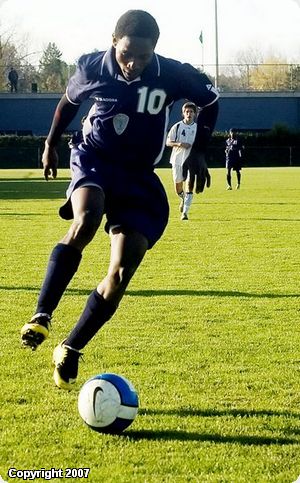 |
| Noor Bulle plays with his fellow teammates at a recent Burlington High School soccer game in Essex. (ALISON REDLICH/Free Press) |
He runs the pitch at BHS in cleats and a navy-blue Seahorse uniform, kicking a regulation ball. His cell-phone message ends with "Peace."
Bulle had traveled a long way to this place. He and his family left their home in Jilib, Somalia, on foot, when civil war broke out in the early 1990s.
He was 2 or 3, and today carries few memories of his homeland. He remembers one day playing outside with his older brother. The boys were playing with toy cars their father made, using sandals for wheels. Older kids came by and chased them "because we don't look like them," Bulle said.
Mostly, the kids stayed inside, afraid of going outdoors. The practice held when night fell at the refugee camps in Kenya where Bulle and his family lived: Dadaab and Kakuma, home to tens of thousands of African refugees.
"The bullies go outside at night," Bulle said.
In the day, instead of going to school, Bulle went to the market to look for food. He said he was too hungry to go to school, too hungry to learn. He told his mother he was going to school, but saw there was no point.
"You need your brain to learn better," Bulle said. His brain wasn't working when he was hungry. The food rations that were meant to last 15 days never did, he said. "You eat a little, so you have enough," Bulle said.
At the market, he'd gather used plastic bags to make soccer balls. He'd wash them out, dry them, and wad them up to form a ball.
One of the difficulties at the camp was trying to make sense of what officials said about immigration to the United States. It was confusing and hard to follow, Bulle said.
You'll go in a few years; you'll go next year; you'll go the next day! Which one was it, and how could you tell?
In all, the family waited eight years -- a period marked by uncertainty, by setbacks and delays. And by holding out hope.
When the time finally arrived, in the summer of 2004, the family said, "Yeah!"
Bulle was sick on the plane to Nairobi, the first step of his journey here, vomiting the whole way. He didn't want officials to know. Any problem might jeopardize resettlement, he thought.
In New York, where the family stopped en route to Vermont, Bulle was in awe of everything he saw, taking in every new sight. "I was so excited," he said, "I wasn't scared of anything."
Being sick on an airplane, trying to digest unfamiliar foods, was easy compared with his first days at BHS, where Bulle was a freshman attending school for the first time.
He dressed differently. He didn't know what was going on. He was teased on the bus. It hurt. He told his teachers he wanted to quit.
"It was too hard for me," Bulle said. He decided to stop taking the bus and started riding his bike to school.
"The teachers were helpful," Bulle said. "They ordered me to learn English."
He remembered the INS official in Kenya who told him to go to America and learn English. He wasn't going to worry about the kids who were "torturing" him.
"I don't care about them," he said. "Whoever I am, good for who I am." Now he says he's friends with the kids who teased him. They respect each other.
He is amazed, delighted -- and gratified -- by the progress he's made studying English: speaking, reading and writing. Learning the language has been "huge" in his adjustment to the country. It's been an enormous effort, marked by incremental gains.
"Every time I go home, I think, 'I don't know how to read and write,'" Bulle said of his early months at school. After 2 or 2 1/2 years, he no longer needed an interpreter. "I was feeling good," Bulle said.
This semester, he has only one English as a second language class in his schedule and expects to graduate in June, the first person in his family to graduate from high school. He's applying to colleges, with dreams of playing soccer at the University of Vermont.
"This is the good life I have now, since I was born," Bulle said.
Contact Sally Pollak at [email protected] or 660-1859. Who is Noor Bulle? WHO: Noor Bulle, Burlington High School senior, age 17
FAMILY: Father, mother, two brothers and three sisters, ages 22 to 4; father works as a janitor at IBM; mother is learning English, caring for children
EXTENDED FAMILY: Includes nephew, Abdullahi, born in Burlington
EDUCATION: First attended school as a freshman at BHS; plans to graduate in June
BORN: Jilib, Somalia
RAISED: Refugee camps in Kenya
INTERESTS: Playing soccer, English language -- reading, writing and speaking
ACCOMPLISHMENTS: Scored four goals in two playoff games to lead Burlington to Division I soccer semifinals; applying to college
GOAL: Attending college, hopefully at the University of Vermont, to study and play soccer
ESCAPING CIVIL WAR: "They kept killing people for no reason. They kill you for food. They kill you for your stuff. ... We walked until the middle of Kenya. It was bush, forest, where nobody lives. ... We sleep on the ground (at U.N. camp) without mattresses. In the morning when you wake up, your body hurts. Scorpions come in your house and bite people."
AT DADAAB REFUGEE CAMP: "It was a crazy thing to live in Dadaab. People don't care about dead people. They feel normal when people die over there. People kill each other, I don't know why." To Bulle, who was just a kid, it seemed like people were dying everyday and everybody had a gun.
IN BURLINGTON: "The biggest change is I come here to go to school. This is the good life I have now, since I was born."
SOURCE: Burlington Free Press, November 11, 2007