
Wednesday, December 26, 2007
NAIROBI (AFP) — The escalating Somali conflict is a "second
Iraq" for
Ethiopia and its international partners who supported the country's invasion, said
Eritrea's information ministry a year on from the invasion.
"Just as the Eritrean government had predicted before hand, the situation in Somalia has become a second Iraq to the TPLF (Ethiopian regime) and its masters," said the statement posted Monday on the information ministry website.
"Now, after it has become clear to all that the war in Somalia has no end, the US administration, the UN and the international community, as a whole, are being forced to admit that their approach towards the Somali issue was indeed wrong," it added.
The statement was posted exactly a year after Ethiopian military planes, with tacit US backing, bombed Islamist positions inside Somalia.
Ethiopian troops then helped Somali government forces force Islamist fighters from the country's southern and central regions, where they had imposed Sharia law.
Ethiopia said it was protecting its borders from the Islamists, who had already declared Jihad (Holy War) on Addis Ababa, but some of its troops have been killed in action, some of whom were dragged through the Mogadishu streets.
"Unfortunately for the TPLF, wars do not prolong life -- they can only shorten it," the statement said.
Asmara's frosty ties with Ethiopia over an unresolved border dispute and the subsequent fall-out over Somalia compelled the Horn of Africa nation to pull-out of a regional peacemaking bloc, the Inter-Governmental Authority on Development that was assigned to deal with the Somali issue.
Eritrea repeatedly urged the world to stop the Ethiopian invasion, warning that it could worsen the situation in Somalia.
Instead the UN accused Asmara of arming the Islamists, some of whom were accused of ties with extremist groups. Analysts accuse Asmara and Addis Ababa of fight a proxy war in Somalia, a charge they both deny.
 |
|
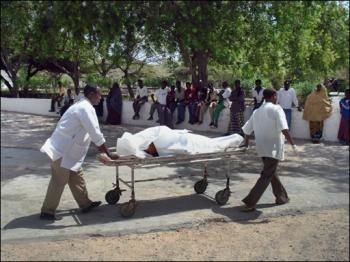
Somali medical personnel carry on a strecher the corpse of a mortar attack victim |
Since then, the Islamist militants have waged an insurgency mainly in
Mogadishu. The militants warned of a long, drawn-out war that will end and peace talks follow after
Ethiopia pulls out its troops.
Last week, Ethiopian Prime Minister Meles Zenawi said the African Union's failure to deploy a promised 8,000 peacekeepers to Somalia had made his troops to stay longer the expected in the lawless nation, home to 10 million people.
The UN has only deployed about 1,800 peacekeepers -- 1,600 from Uganda and 200 from Burundi -- in the country who have neither been able to bolster the feeble government of President Abdullahi Yusuf Ahmed nor protect humanitarian supplies.
The UN Security Council, last Wednesday, renewed its call for the world body to pursue contingency planning for deploying a peacekeeping force in the country, and expressed "grave concern" at the humanitarian situation.
The joint UN-US peace mission in Somalia in the mid-1990s ended after it pulled out in the face of escalating clan conflict that killed more than 140 UN peacekeepers and 18 US special forces.
The violence has forced hundreds of thousands of people to leave Mogadishu in recent months, according to the United Nations, prompting warnings of an unprecedented humanitarian disaster.
Aid agencies have said that conflict is choking off efforts to deliver humanitarian supplies to those affected.
Meles has accused UN agencies of "hype and exaggeration," in their reporting of the humanitarian situation in Somalia.
Numerous bids to restore stability to Somalia since dictator Mohamed Siad Barre was ousted in 1991 have failed because of clan warfare and unrest.
Source: AFP, December 26, 2007