
Thursday, December 20, 2007
By EDITH M. LEDERER
UNITED NATIONS (AP) — The Security Council asked the U.N. chief on Wednesday to plan for the possible deployment of a United Nations peacekeeping force in
Somalia to replace African Union troops.
The council was reiterating a request it initially made in August which U.N. Secretary-General Ban Ki-moon rejected.
The council also said it looked forward to hearing more details of proposals by Ahmedou Ould-Abdallah, the new U.N. envoy for Somalia, on improving security and promoting political reconciliation in the conflict-wracked nation which has not had an effective government since 1991.
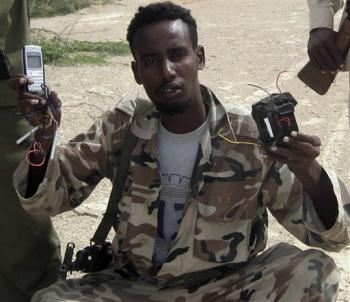 |
| A Somalia government soldier displays components of a remotely controlled landmine with a mobile phone, which was found near a road in Bal'ad in the north of Mogadishu, Somalia, Tuesday, Dec. 18, 2007. Attackers usually detonate handmade landmines like this by remote control as government vehicles pass by, along the main roads in Mogadishu. (AP Photo/Mohamed Sheikh Nor) |
Ould-Abdallah on Monday urged Saudi Arabia to use its "moral authority" to get more troops on the ground and bring the opposing parties together to help end the violence in the Horn of Africa nation. He said Saudi, the custodian of the two Muslim holiest sites and a close neighbor with many Somali refugees, should be invited to play a leading role.
He said he wants to simultaneously launch new political talks and a new security initiative that would beef up the 1,800 AU troops from Uganda now on the ground in Somalia as an interim measure, ahead of an eventual takeover by U.N. peacekeepers.
With the support of the secretary-general, Ould-Abdallah said he plans to pursue this two-track "road to peace" without delay because security is deteriorating daily.
He asked council members for their support and told reporters afterward their reaction was "very positive."
A statement from the Security Council read at a formal meeting Wednesday welcomed the U.N. envoy's call on the international community to commit itself to a clear course of action. But the council did not make a commitment.
Instead, the statement from the 15 members said the council looks forward "to the early establishment of an effective government" in Somalia and urged all Somali parties "to reject violence and ... to enter into a substantial dialogue aimed at achieving a full and all-inclusive national reconciliation," with the support of Ould-Abdallah.
Somalia has not had a functioning government since clan-based warlords toppled dictator Mohamed Siad Barre in 1991 and then turned on each other, sinking the poverty-stricken nation of seven million people into chaos. Its weak transitional government, backed by Ethiopian troops, is struggling to quash an Islamic insurgency that has killed thousands of civilians this year.
The 1,800 Ugandan peacekeepers who arrived in Somalia early this year are officially the vanguard of a larger African Union peacekeeping force, although no other country has sent reinforcements so far. In August, the council called on the secretary-general to begin planning for the possible deployment of U.N. peacekeepers to replace the AU force.
Ban opposed a U.N. deployment in early November because of heavy fighting and suggested instead a robust multinational force or a coalition of volunteer nations to help restore security. But in late November, the council rejected Ban's opposition and underlined its call for contingency planning for a U.N. peacekeeping force.
In Wednesday's statement, the council reiterated that request.
Source: AP, December 20, 2007