
By Ysain Bu'ul
Saturday, April 07, 2007
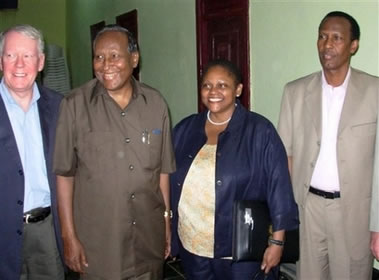 |
| U.S. Ambassador to Kenya M.Ranneberger, President Abdullahi Yusuf, U.S. Assistant Secretary of State for African Affairs Jendayi Frazer & PM Ali Mohamed Gedi, (AP Photo/Mohamed Abdulle Siidi) |
advertisements
The fighting was sparked by an offensive to wipe out a persistent insurgency before an April 16 national reconciliation conference.
Frazer told reporters in Baidoa that her message to all she met was to "stop the violence now and have a permanent ceasefire mechanism in place. Peace will come through dialogue and not fighting."
A joint Somali-Ethiopian offensive led to entire pro-insurgent neighbourhoods being demolished with rockets, tanks and artillery from March 29-April 1, in fighting that killed at least 400 people and wounded about 1,000.
The interim government must get the reconciliation underway so that an inclusive government, security forces and constitution can be finished in time for elections in 2009, when the current administration's mandate is due to end, she said.
NATION IN ANARCHY
Despite nearly a week with only sporadic gunfire -- the norm in Mogadishu -- many doubt the security situation will improve enough in time for the start of the conference, which is designed to bring together all sectors of Somali society.
Diplomats see the meeting as the government's only chance to gain the legitimacy and inclusiveness it needs to lead a nation in anarchy since the 1991 ousting of dictator Mohamed Siad Barre.
Frazer also said that the Washington still believed that three top al Qaeda suspects, plus three Somali associates are still in the country.
"Unfortunately, Somalia has become a haven for terrorists, and the al Shabaab militia took part in the last fighting that happened in Mogadishu," she said, before flying back to the Kenyan capital Nairobi.
The Shabaab is a feared Islamist combat unit led by Adan Hashi Ayro, a leader of the Islamist movement that Ethiopian and Somali forces routed in a two-week war over the New Year with U.S. backing that included two air raids.
Rebel attacks, carried out by defeated Islamists trained in insurgency and gunmen from Mogadishu's dominant Hawiye clan, and the government's responses have sent 124,000 residents -- a tenth of Mogadishu's population -- fleeing since February.
Indiscriminate shelling in last week's assault prompted a European Union investigation into possible war crimes by Ethiopian and Somali troops, and also by African Union peacekeepers from Uganda who failed to stop them from happening.
Ethiopia, Somalia and Uganda all deny wrongdoing.
Somalia's interim government is the 14th attempt to establish central rule in the Horn of Africa nation since 1991. Frazer has said she sees this current time as the best opportunity since then to create a lasting government.
(Additional reporting by Bryson Hull in Nairobi and Sahal Abdulle in Mogadishu)
Source: Reuters, April 07, 2007