
By Sophie Walker
Thursday, February 22, 2007
 |
|
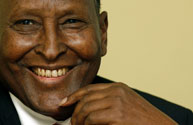
Somalia's President Abdullahi Yusuf Ahmed smiles as he speaks at a news conference at Chatham House in London, Feb. 22, 2007. |
advertisements
The Islamists who survived scattered back to their clan areas and have vowed to fight an insurgency against the government and a planned 8,000-strong African Union (AU) peacekeeping force.
The government also faces the threat of well-armed criminal gangs and warlords who hope to regain turf lost when the Islamists took control of Mogadishu in June.
Experts say the unrest has little chance of abating until the government reconciles with clans who feel excluded from the political process. Western diplomats have pressed Yusuf to convene a reconciliation meeting.
Yusuf said disarmament was progressing in Mogadishu, where Ethiopian soldiers are helping the government to hold the capital amid daily mortar attacks and gunfights.
"Disarmament has started. Up til now it is voluntary. We have completely disarmed former warlords and we will continue to disarm the population, on a voluntary basis for the time being. But if (people) won't disarm voluntarily we will do (it) by other means," he said.
Asked whether he would close down the city's busy gun markets, Yusuf said: "Of course."
Yusuf said Ethiopia's troops would withdraw when the African Union peacekeeping force arrived and said he was confident the Somali government could control Mogadishu without the help of its neighbour.
"Of course, yes. We are training and equipping our own security forces," he said.
The Ugandan, Burundian and Nigerian troops who will deploy in Somalia will be heading into a country that resisted order and authority for 16 years of anarchy since dictator Mohamed Siad Barre's ouster in 1991.
Insurgents have threatened to attack any peacekeepers who arrive in the country. But Yusuf said he believed the presence of foreign troops would not further aggravate the situation or undermine his position.
Source: Reuters, Feb 22, 2007